The Aicme's (Blog)
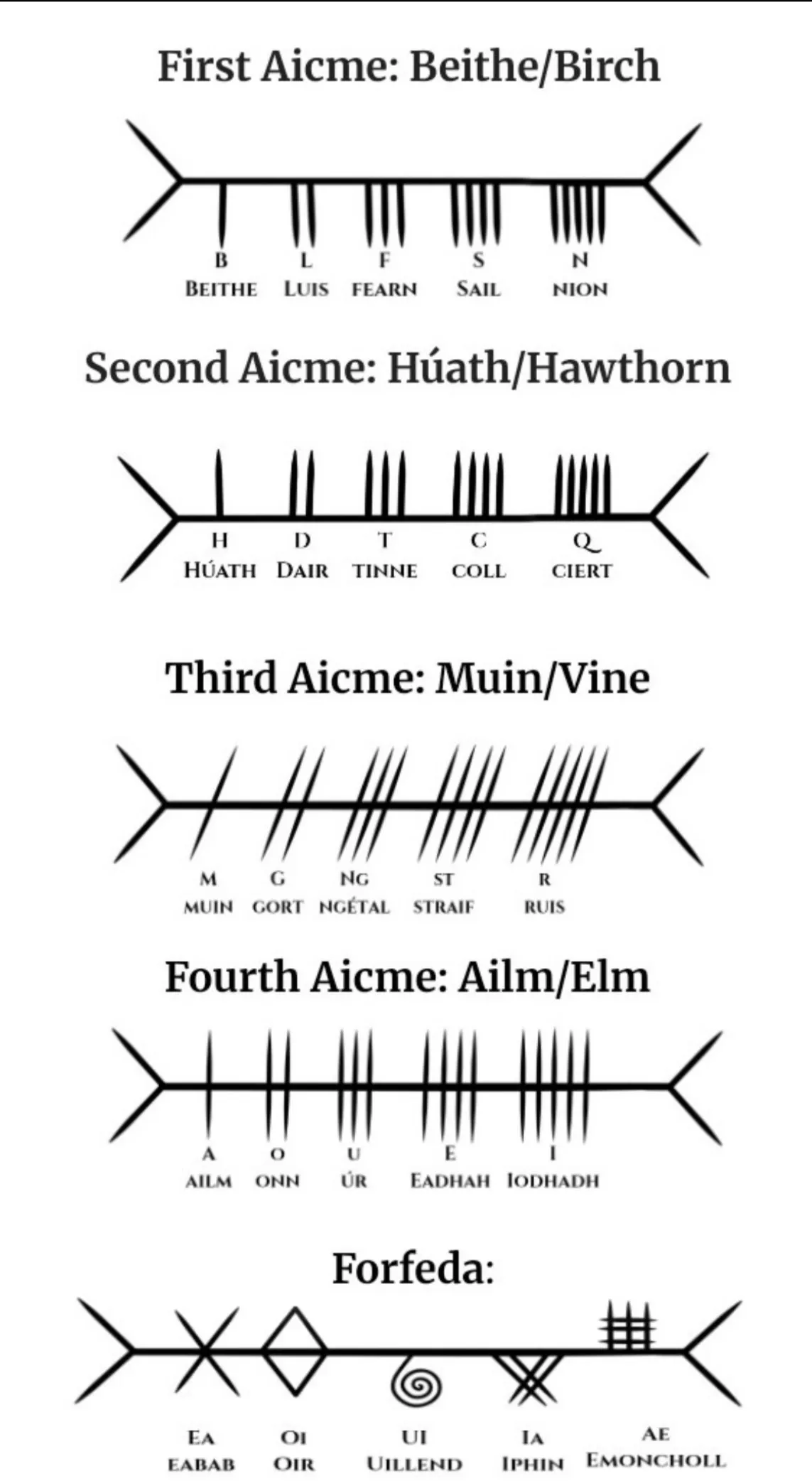
Ogham, is one of the few known alphabets that are written and read vertically from the bottom to the top. Its twenty letters, called Feda (trees), group into four Aicme (family) of five letters each; reminiscent of the Elder Futhark’s Aetts. Each letter is simply a cluster of one to five straight lines, scratched or carved along the (usually) vertical edge of a stone. The different Aicmes were assigned the name according to the first Feda of each Aicme, ex. The first Aicme is Beithe’s Aicme due to the first Fid being Beithe.
The first Aicme (B, L ,V/F, S, N) has lines drawn to the right or facing downwards when horizontal of the center stave.
The second Aicme (H, D, T, C, Q) has lines drawn to the left or upwards when horizontal.
The third Aicme (M, G, NG, ST, R) draws its lines diagonally across both sides of the center stave.
And the fourth Aicme (the vowels A, O, U, E, I) is drawn either as short marks on the stave itself, or straight across both sides of the stave.
A much later manuscript adds in an effort akin to the Futhorcs etymological changes an additional Aicme called the Forfeda was added to the existing system found in the “Lebor Ogham” called the Forfeda (where for) that uses more complex symbols to write a mix of consonants and vowels from the much later Old Irish period.
The Forfeda also adds another five Fid bringing the total amount of Feda commonly seen to twenty five. Only one of the Forfeda letters (the simplest one, a X across the center) is ever found in the earlier inscriptions, however, and often has a significantly different use than the manuscript tradition suggests.