Now lets make some BindRunes. (Blog)
Bind Runes
The Background on the Binds:
Now that you (probably) are creating or have already created your Rune set you may be wondering what those magical correspondences within each Rune section are really meant for in regard to the use of Runes. Besides Galdr (which is our next section), the next biggest, if not more prominent, use of runic magic is my favorite discipline of magic, and that is the Bind Rune. My goal in this section of the book is to answer what a Bind Rune is, how do we know of them, how are they structured, what can we use them for, and of course how do we make them. Let's start with what a Bind Rune is: A Bind Rune is any magical formulation or ligature of two or more runes from the various Runic systems.
This is a very simple explanation for what used to be a very simple practice. It has been formed by the historical and archaeological societies as a whole due to what we know from the finds of Bind Runes and other ligature works from the time period we consider the “Viking Age.” Two awesome examples to look at are the Kylver stone from 400 A.D. (mentioned earlier in the book) with its repeated Tiwaz inscriptions, and the Södermanland Runic Inscription 158 (or Sö 158), a memorial runestone located in Sweden first in the 17th century bearing imagery of a ship and inscribed with same-stave Bind Runes to commemorate a man’s promotion of sorts.
Then we can look at our sources of lore. For our purposes, we will look specifically at the Sigrdrífumál section of the Poetic Edda where one of the lengthiest descriptions of the various kinds of magical runes is found. Unfortunately for us, the list does not go far beyond what the name of the charm or spell is, oftentimes just describing what each type of magic the runic based spell applies to. Another interesting facet, that ties into the relevance of needed shorthand, is that the majority of Bind Runes found and studied are almost never more than three runes, tending to favor the number two for simplicity's sake.
If we don't even know what runes the spells are using, how can we apply them? We look to what we do know. The goals of most Bind Runes actually uncovered from the Viking Age follow the usage and ease of shorthand of the Younger Futhark, and were used as a shortening of words, marks, companies and even inventory much like branding irons. There's also some classic examples of someone writing “this is mine” and having what looked like a Bind Rune next to it on a hammer or another kind of tool. Also to be perfectly honest I wouldn't be surprised if they were similar to modern companies logos or if there were others made and used for familial names and in turn legacy or memorials sake.
Why are they so popular and, in the eyes of many practitioners, running rampant? Bindrunes have gained popularity due to their intriguing blend of ancient mysticism and contemporary spirituality. They take the simplicity of the sigil and enhance it with ties to deities and cultures, and even provide a needed discipline within the craft. In my class “The Vörðr’s Way” that I wrote for The Fellowship of Fire and Ice, I describe the difference between sigils and Bind Runes as,“where sigils are abstract alchemy being brought to life, Bind Runes are the alchemy of the natural laws.” The inherent agency the Runes hold to themselves have lended this definition to the craft of Bind Runes. They have become very much their own spirits, and as such I have taken to referring to them as the Rúnvættir (thank you to Sarenth Odinsson of Around Grandfather Fire for the term), and in turn they have gained a divine sense over the ages, from being used as shorthand to now being a complex magical practice in their own right. Oftentimes they are visually appealing, and beings believe in their efficacy for personal empowerment and spiritual connection. While opinions vary, Bind Runes hold significance for many individuals who integrate them into their spiritual practices.
How do we make them?
This will be the first time in my practice that I will be laying out how to actually make Bind Runes in a cohesive and hopefully inspiring manner. The art and practice of Bind Runes have always been a part of me, since taking up my path. They have been an extension and application of my own intuition, being led and guided by the Powers of Yggdrasil, Wyrds Web, and the Rúnvættir themselves, to bring forth those musings and inspirations that have become my craft.
When I set out to make a Bind Rune, I can be anywhere and be doing anything. When I create or transcribe a Bind Rune from an apparent clair cognitive “divine download,”, it flows from my mind to my hands, and with my intuition guiding, I allow the rune to flow forth onto the paper, sidewalk, tablet, phone, or even skin. These situations are not always pleasant: maybe I need to ward my car, or give someone healing, or someone needs a financial pick me up. Using the last example, I may hide a prosperity Bind Rune on a bank note somewhere. That's the beauty of Bind Runes in my eyes: they are every bit as free and unique as a sigil, but instead of feeding them your personal energy or channeling outside energy to bring them to life, Bind Runes are alive from the time you start planning them. The Rúnvættir’s energy flows through your fingertips, as you become the conduit for an awesome and ancient magic.
This isn't to say that the only times you can create are when you feel called or are given a “divine download” of some sort; it is more of a way to describe the relationship that is required to truly make Bind Runes and not something that just looks like one. When setting out to make a Bind Rune in my system, you are agreeing to enter a partnership with the Runes. You affirm that you will respect, honor and listen to the runes you are asking to take part of the Bind Rune you are creating, and they in turn will grant you their energy and agency to help bring your Bind Rune to fruition. This next statement is not to play gatekeeper, and it is something I tell everyone who is new to divination, Paganism, Heathenry, or the realms of Spirituality when they ask me how to make Bind Runes. Bind Runes require an intimate relationship with the linguistic systems we call the Runes and the Rúnvættir. As spirits they are their own individual beings, and in order to truly work with them in the sense of making spells, charms, chants, poems, or Bind Runes, they deserve to be known as individuals, so if you are not at that place in your runic journey, I encourage you to further it, until you can answer yes: yes I do have that type of relationship with the Runes.
If you answered yes to the statement above the next parts are for you. I will be breaking down the making of a Bind Rune into a formulaic style to help build those bridges of intuition in yourself until you get to the point that you, like me, can be a conduit and allow your Bind Runes to take on a style all their own. I will break the process down into two main categories of multiple steps: The brainstorming phase, and the crafting phase. Before we get to that part however, let's discuss the different types of Bind Runes seen throughout history and why they still stand up to the test of time. It's also worth noting, I am self taught; using less than three runes in a Bind Rune was never something taught to me, or that one can't mix styles. This led me to develop a style all my own that has grown with me over the years. Do not feel that the guidelines and steps I bring forward are the only way to make Bind Runes, they are merely your introduction, a jumping off point for you to discover this world of magic, and to inspire you to find all the ways you can make sigils, Bind Runes, and alchemy in the most contemporary of ways.
There are 3 main types of BindRunes seen historically. They are stacked, same stave, or radial, which is a reminder or remains from the Galdrastafir of Icelandic magic practices
All examples will be in Elder Futhark for ease of explanation.
Stacked Bind Runes:
Stacked Bind Runes are the most common type that we actually see used. For a stacked Bind Rune, you take the runes you're working with, and “stack” them upon each other, making what appears to be a new runic shape altogether. These are mid level in difficulty because, depending on the way you stack them, hidden runes are revealed. Hidden runes are the unintended runes that are seen in the image of a Bind Rune after its final design, and an experienced practitioner will use those hidden Runes to layer the meaning or usage of the main Bind Rune. Stacked Bind Runes are most easily made by adhering to the less than three Runes concept.
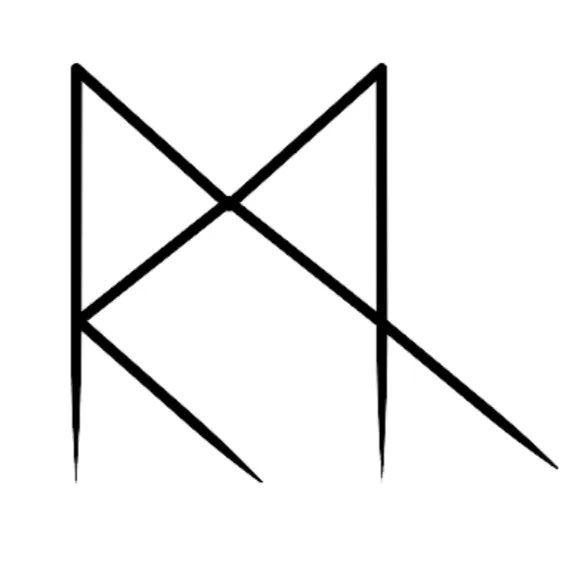
This example is made up of the letters M (ᛗ), N (ᚾ), and R (ᚱ), which are Mannaz, Nauthiz, and Raidho. I chose these as they are the initials for the organization my sister and I co-founded, Moons and Runes. I wanted to make a Bind Rune using those initials to reflect the type of space we try to foster for our members. With Mannaz we are focusing on the soul and the self and what it needs, which takes us to Nauthiz: the needfire and how we try to help people get what they need in our organization. That brings us to Raidho: it's all about the journey and whether or not a member is with us for a long or short period we want them to feel at home and that Moons and Runes is a place that is safe and that they can come back to at any time. This can be echoed in the generosity of the hidden Gebo and the healing nature of the Ur revealing itself on the right side of the Bind Rune.
Same Stave Bind Runes:
Same Stave Bind Runes are in my opinion the most common. This is because this is where most Rune crafters start building Bind Runes when they begin to dip their toes into the practice. That's due to the fact that you draw one main stave (line) and then place your Runes along that line in a process that executes your goals. Same Stave Bind Runes are most commonly seen as depicting names for phrases similar to the Celtic Ogham system, but instead of being read bottom to top, Same Stave Bind Runes are read in the orientation chosen by crafter. Same Stave Bind Runes have a bit more flexibility when looking at historical examples, with most being anywhere from three to five Runes on one stave. Even some of the ones I've done had (if I recall correctly) about thirteen or fourteen runes on a main stave.
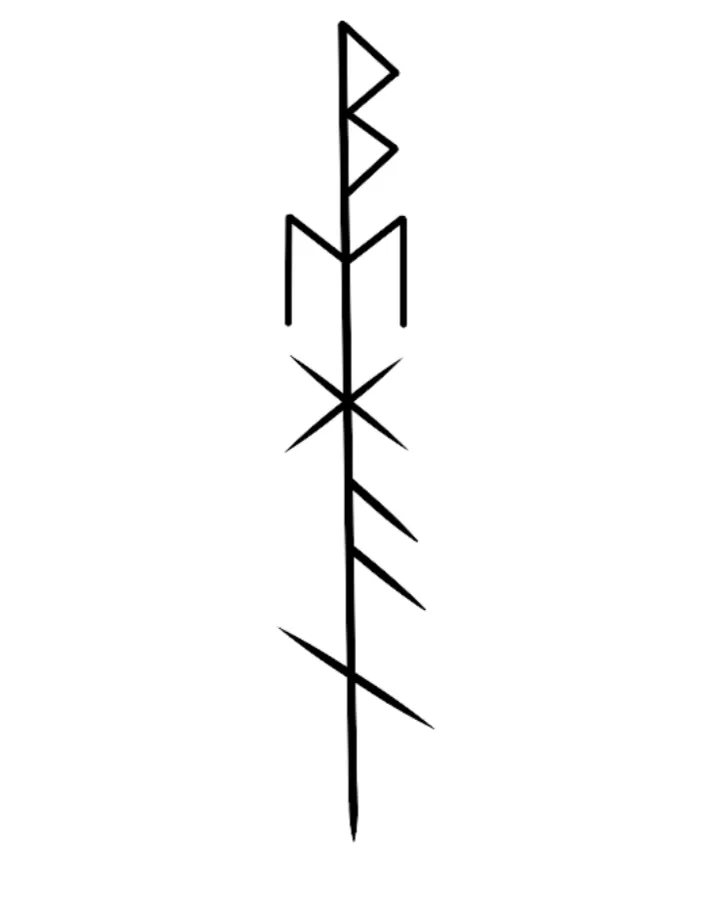
For the purpose of this Same Stave Bind Rune, I wanted to demonstrate how different Runes would look along the main stave, so I opted to use Berkano (ᛒ), Ehwaz (ᛖ), Gebo (ᚷ), Ansuz (ᚨ), and Nauthiz (ᚾ), which spells “began.” To me this word on its own is full of magic because of the fantastical stories of Arthurian times that started with “and so it began.” It is my hope that this book serves as your “and so it began,” when you recall your craft at a later date.
Radial or Galdrastafir Bind Runes:
These are in my eyes the most famous style of Bind Runes and that is due in part to the ongoing controversy of two symbols: The Vegvisir and the Helm of Awe. Both are important symbols in today's neo-pagan society, and Norse Pagans argue whether they are historical Norse symbols or not. That is not a conversation for this space, but those conversations have made this style of Bind Rune famous the whole world over, and recognizable by almost anybody. What we draw from them is the way they are arranged and built. Both symbols are built in a “compass style,” where there is a central focal point, and the Runes used are laid radially using staves to keep branching out. This style has most influenced my own subconscious, and has been dubbed “the pretty snowflakes” by my kids and kin. In fact, it is a creation of this style that has earned the greatest compliment I will ever receive in regards to my craft. It was when a mentor of mine called me the next Skuggi, referring to the author of an amazing book on Icelandic magic, including some of the best Galdrastafir I've ever seen, called the Sorcerer's Screed, which was first published in 1940. Radials are in my opinion the best for spellwork and rituals, as well as coding multiple intentions and layering different goals within, making it a labyrinth of runic magic designed by both you and the Runes. Another key distinction is that when using a Radial template you have the flexibility to use other systems in conjunction with the Runes, either different Runic Systems, Ogham, Witch's Runes, traditional Sigils, or even Goetic if you are versed in those disciplines. In the example I provide below, you can see just how easy that can be.
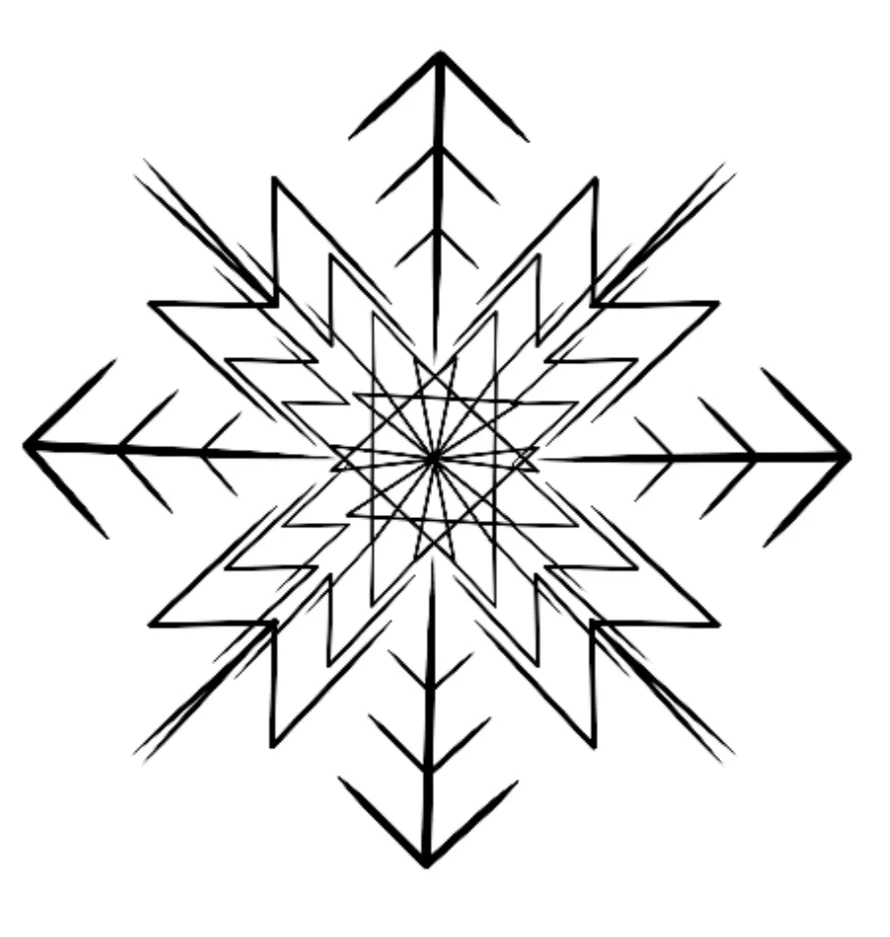
This example of a Radial Bind Rune is designed for truth seeking and bringing justice to the forefront. To do this I used Tiwaz (ᛏ), Ehwaz (ᛖ), Mannaz (ᛗ), Dagaz (ᛞ), and Sowilo (ᛋ). An interesting facet of this was the incorporation of the traditional Witchcraft symbol of the Pentacle, which draws on the elements as well. I placed Tiwaz in the four cardinal directions to show that everything will be uncovered, and the stacked Ehwaz amplifying from the base Mannaz are there to motivate the target to come forward, making them go on an introspective journey, and feeling all the things that go with that. Then we get to the center where Dagaz makes its home and the intersecting Bind Runes form multiple Sowilo, and Pentacles, calling for illumination and the elements of natural power to restore order to the land.
The steps in making a Bind Rune: My 2 Phase Method
The Brain Storming Phase:
What is your intention? What do you want to happen, change, or accomplish? Why do you want this?
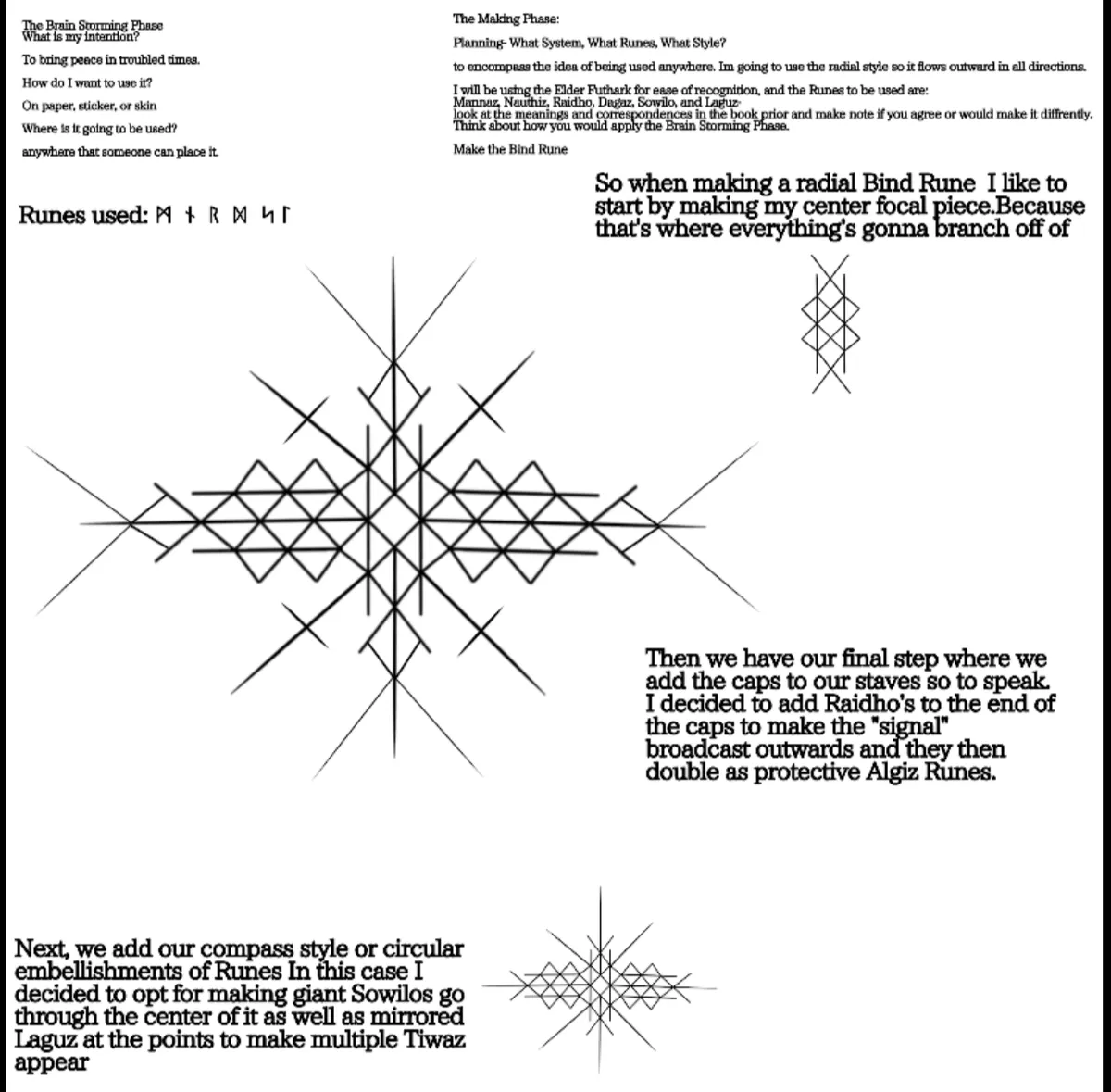
As I wrote in the graphic build, I want to make something that brings the user and its targets peace in troubled times.
How do you want to use it? Do you want this to be a drawing on a paper for a one time use spell? Are you making this to share with people? Will it be a tattoo? In all the ways you can apply something, it's important to decide which method of application is right for the Bind Rune at hand.
I want it to be able to be used in a variety of ways: to be used on paper, skin, stickers, or just drawn on a surface. With both the intention and how I want it used, that means I need to formulate this Bind Rune so that it can be easily drawn and charged by anyone who wants to use it.
Where is it going to be used? Essential to the process just as much as the how is the where: do you want this to be seen? Is it being used for glamour magic? Is it a curse on someone? Is it an amplifier that needs to be seen by all? Is this to be seen on your person as a mark of who you are, or to be put on materials to bring a desired outcome? The list goes on and on.
The goal for this Bind Rune is to be applicable anywhere and everywhere that someone wants to use it.
With the other pieces of brainstorming in place, we are setting this Bind Rune up to be a versatile piece of magic.
The Crafting Phase:
Planning- What System, What Runes, What Style?
This really is as plain as the heading: you must determine which aspects of the systems you know that you want to use, and which runes you know that correspond with the results of your brain storming. Once you have answered that, then you have to try to decide which of the styles you might use, or even create your own style to be used. Experimentation is key to growth.
For this Bind Rune, we are going to make it in a radial style so the energy flows in all directions, and we are going to use the Elder Futhark system for recognition's sake. The runes to be used are: Mannaz, Nauthiz, Raidho, Dagaz, Sowilo, and Laguz (Think back to the meaning and correspondences in the prior sections of the book and make note of how or why you might do this differently).
Make the Bind Rune.
Now it's time to put it all together, draw, then redraw, then redraw some more, allowing your intuition to guide you. Make changes until the Bind Rune in front of you echoes with your intuition, the Runes, and your own magic.
Charging or “releasing” the Bind Rune.
When we look at the aspects of charging and releasing Bind Runes we are reminded of sigil crafting. And we should be: many of the methods we use to activate sigils through charging and releasing apply to Bind Runes. Some of those methods can include: smoke, fire, dirt, bodily fluids including blood, water of multiple types, tearing, inking on different surfaces, or writing out the working for activation and release.
The main difference is that we can “broadcast” a Bind Rune upon completion of construction by simply recognizing that it is completed and ready for use.
Oftentimes I build the activation into the Bind Rune itself as part of its makeup. Hiding the activation within the Bind, it is to remain inactive until someone who's not me draws it, for example. This is my favorite part of making Bind Runes: this inherent aspect of “coding” in a sense and structuring a full spell or ritual inside this now living aspect of Runes art and my own crafting. This is where Rune crafters truly find their personal style and discover the intimacies of Bind Rune making and why none, like a snowflake, truly are alike.